.png)
FROM CONSUMER CREDIT INNOVATION TO A FEDERATED CREDIT INFORMATION GOVERNANCE FRAMEWORK: RETHINKING CONSUMER CREDIT RISK MANAGEMENT
- tealbeltinfo
- Jul 9
- 29 min read
FROM CONSUMER CREDIT INNOVATION TO A FEDERATED CREDIT INFORMATION GOVERNANCE FRAMEWORK: RETHINKING CONSUMER CREDIT RISK MANAGEMENT
TABLE OF CONTENT
ARTICLE SUMMARY
Consumer credit ecosystem has attracted increasing attention from retailers, financial institutions, investors, regulators, and policymakers. Much of the existing discussion has focused on consumer protection, credit reporting, and regulatory oversight. While these issues are important, this article, using Buy Now Pay Later (BNPL) as exemplifier, argues that they are symptoms of a broader structural transformation taking place in consumer finance.
The central proposition of this article is that the evolution of modern consumer credit can be understood through four interconnected stages.
Innovation - Distribution - Fragmentation - Governance
Financial Innovation has transformed a centuries-old commercial practice into a sophisticated digital financial ecosystem. Together with innovation in digital platforms, artificial intelligence, Open Banking, Open Finance, Embedded Finance, Banking-as-a-Service, private credit, digital identity, and related technologies, BNPL has fundamentally changed how consumer credit is originated, funded, distributed, and managed.
As financial innovation has accelerated, consumer credit has become increasingly distributed across multiple participants. Money, information, and risk are no longer concentrated within a single financial institution but flow through an interconnected ecosystem comprising consumers, merchants, BNPL providers, banks, payment service providers, credit bureaus, private credit investors, technology providers, and regulators.
However, governance has not evolved at the same pace. Existing consumer credit governance remains largely institution-centric, with each participant managing its own information and risks. As credit information and financial risks become increasingly distributed, governance becomes fragmented, creating challenges for risk visibility, accountability, interoperability, and ecosystem-wide oversight.
DECLARATION
Using BNPL as the motivating case rather than the sole subject of study, this article proposes a Federated Credit Information Governance Framework to address this emerging governance gap. Rather than proposing a definitive solution, the framework is intended as a conceptual foundation for future discussion, policy development, industry implementation, and research into consumer credit governance in an increasingly distributed financial ecosystem.
The remainder of this article follows the logical progression of Innovation – Distribution – Fragmentation - Governance, demonstrating how financial innovation has reshaped consumer credit and why governance innovation has become the next critical stage in the evolution of digital financial services.
1 FINANCIAL INNOVATION: THE EVOLUTION OF BUY NOW, PAY LATER
1.1 The Evolution of Consumer Credit
This article uses Buy Now, Pay Later (BNPL) as the example to illustrate how consumer credit innovation has challenged traditional consumer credit governance.
The concept of buying goods immediately and paying for them later is far from new. Throughout history, merchants have extended credit to trusted customers as a practical means of facilitating commerce and maintaining long-term customer relationships. The modern Buy Now, Pay Later (BNPL) model therefore represents an evolution of established commercial practice rather than the creation of an entirely new financial product.
The evaluation of BNPL can be broadly divided into four stages.
Traditional Merchant Credit
Local merchants, such as grocery stores and rice merchants, commonly allowed customers to purchase necessities on credit and settle their accounts after receiving their wages. Credit decisions were based primarily on personal trust and local knowledge rather than formal credit assessment.
Hire Purchase and Instalment Finance
Industrialization and the growing affordability of household appliances and motor vehicles led to the emergence of hire purchase and instalment financing. Credit became institutionalised through finance companies, allowing consumers to spread payments over longer periods while enabling merchants to expand sales.
The Credit Card Revolution
The widespread adoption of credit cards transformed consumer finance by centralizing credit provision within regulated financial institutions. Credit bureaus, payment networks, and banking regulations established a relatively integrated and institution-centric consumer credit ecosystem.
Digital BNPL
The latest stage combines traditional instalment financing with digital technologies, platform-based business models, real-time credit assessment, and alternative funding arrangements. Although the underlying concept remains “buy now and pay later,” the operating environment has changed fundamentally.
Key Observation
BNPL is not a new financial concept. What has changed is the manner in which consumer credit is originated, funded, delivered, and managed.
1.2 Financial Innovations Behind Modern BNPL
Recent developments in consumer finance have been driven by innovations such as Embedded Finance, Buy Now, Pay Later (BNPL), Agentic AI, Open Banking, and Financial Super Apps. While these innovations have significantly enhanced customer convenience and expanded financial inclusion, they also introduce new governance, regulatory, operational, and legal challenges as information, funding, and risk become increasingly distributed across multiple participants.
BNPL is distinguished not by the repayment concept itself but by a combination of innovations that have transformed a traditional financing arrangement into a scalable digital financial ecosystem.
Technology Innovation
Technology provides the infrastructure that enables instantaneous credit decisions and seamless customer experiences. Key developments include mobile applications, AI-assisted credit assessments, application programming interfaces (APIs), real-time payment infrastructure, digital identify technologies, and cloud computing. Together, these technologies enable financing decisions, information exchange, and customer interactions to be integrated directly into the purchasing journey.
Business Model Innovation
Equally important are innovations in business models. Embedded finance enables financing to be offered at the point of sale, often without requiring customers to visit a financial institution. Merchant-funded financing, platform ecosystems, and one-click financing have significantly reduced transaction friction while expanding the commercial reach of BNPL providers.
Funding Innovation
The funding structure supporting BNPL has also evolved. Rather than relying solely on balance-sheet lending, many providers now utilise private credit funds, institutional investors, forward-flow agreements, and securitisation structures. Consequently, the ultimate providers of capital may differ substantially from the customer-facing BNPL platform, resulting in the distribution of funding, information, and credit risk across multiple independent organisations.
As funding structures become increasingly distributed, information and credit risk has become distributed across multiple organisations, creating governance challenges that traditional institution-centric consumer credit frameworks were not designed to address.
Customer Experience Innovation
Customer experience has become a key competitive differentiator. Instant credit approval, frictionless checkout, flexible repayment options, and fully digital onboarding processes have made consumer financing significantly more convenient than traditional lending channels.
Key Observation
Innovation has transformed a centuries-old payment arrangement into a highly scalable digital financial ecosystem where technology, funding, information, and customer experience are tightly integrated. This transformation has also distributed information and risk across multiple independent organisations, creating new governance challenges that extend well beyond BNPL.
1.2.1 Why BNPL Raises Eyebrows
The increasing attention devoted to BNPL is not because deferred payment is a novel concept. Rather, modern BNPL combines multiple innovations that collectively raise new questions for financial institutions, regulators, and policymakers.
Rapid market growth has increased the visibility of BNPL as an important segment of consumer finance. At the same time, concerns have emerged regarding consumer indebtedness, multiple concurrent borrowing, and the extent to which some obligations may be visible across different lenders. The growing involvement of private credit funds, institutional investors, and alternative funding structures has further distributed financing risk beyond traditional banking institutions, potentially resulting in fragmented information, educed risk visibility, and less comprehensive ecosystem-wide risk management.
Regulators have responded by examining issues such as responsible lending, affordability assessments, disclosure requirements, consumer protection, and credit reporting. Advances in AI-assisted underwriting and the increasing distribution of consumer information, funding, and risk across multiple participants further complicate the governance landscape.
Importantly, these concerns should not be interpreted as shortcomings unique to BNPL. Instead, they illustrate a broader transformation in the consumer credit ecosystem. The significance of BNPL lies less in the product itself than in what it reveals about the changing structure of modern consumer finance.
The issue is not whether consumers buy now and pay later. The more fundamental question is whether consumer credit governance has evolved at the same pace as financial innovation. To answer this question, it is necessary to examine how innovation has transformed consumer credit into an increasingly distributed financial ecosystem.
2 DISTRIBUTED CONSUMER CREDIT: THE NEW FINANCIAL ECOSYSTEM
2.1 The Evolution of the Financial Ecosystem
The evolution of Buy Now, Pay Later (BNPL) reflects a broader transformation taking pace across the financial services industry. While BNPL is often viewed as an innovative payment solution, it is in face one manifestation of a much larger shift in the way financial services are designed, delivered, funded, and governed.
Over the past decade, financial institutions have increasingly adopted digital technologies and platform-based business models to improve customer experience, operational efficiency, and market reach. At the same time, technological developments have enabled financial services to be offered beyond the traditional boundaries of banking institutions. As a result, financial products are no long delivered solely by banks but through interconnected ecosystems involving banks, fintech companies, merchants, payment providers, technology firms, investors, and regulators.
Several major developments have contributed to this transformation.
Open Banking enables customers to authorise the secure sharing of banking information through standard interfaces, encouraging competition and innovation.
Open Finance extends this concept beyond banking by integrating a wider range of financial products and customer data, creating a more comprehensive financial ecosystem.
Embedded Finance allows financial products, including lending and insurance, to be integrated seamlessly into non-financial platforms, enabling consumers to obtain financing during the purchasing process without visiting a traditional financial institution.
Banking-as-a-Service enables licensed financial institutions to provide regulated banking capabilities through technology platforms, allowing non-bank organizations to offer financial services under collaborative arrangements.
AI-driven lending enhances credit assessment, fraud detection, customer profiling, and lending decisions through data analytics and machine learning techniques.
Digital identity provides trusted mechanisms for customer identification, authentication, and electronic Know-Your-Customer (e-KYC) processes, enabling secure digital onboarding.
Tokenised Assets are beginning to transform the representation and transfer for financial assets, opening new possibilities for financing, settlement, and collateral management.
Private credit has emerged as an increasingly important funding source, allowing institutional investors to finance consumer lending outside traditional banking balance sheets.
Collectively, these developments have fundamentally reshaped the financial landscape, financial services are no longer organised around individual institutions but around interconnected ecosystem in which multiple participants jointly originate, fund, process, and manage financial products.
Key Observation
Financial innovation has transformed consumer finance from an institution-centric model into an ecosystem-centric model.
2.2 Federated technologies: The Foundation of Distributed Financial Ecosystems
The transformation of financial services has been made possible not only by new business models but also by significant advances in digital technologies.
Emerging Federated Technologies
Among these developments, federated technologies have emerged as an important foundation for enabling collaboration among independent organisations while allowing each participant to retain stewardship over its own information, systems, and operational responsibilities.
Unlike traditional centralised architectures, federated technologies enable information to remain under the stewardship of the organisation that legitimately collects or maintains it.
Through standardised interfaces, secure communication protocols, and governed access mechanisms, authorised participants can exchange information, perform analytics, and coordinate decision-making without requiring the permanent centralisation of underlying datasets.
Examples of federated technologies include federated data exchange, federated identity management, federated analytics, federated learning, privacy-enhancing technologies, secure application programming interfaces (APIs), and distributed data architectures.
Collectively, these technologies facilitate interoperability while preserving organizational autonomy, data privacy, information security, and regulatory compliance. However, technological interoperability does not in itself create governance interoperability. Independent organizations must still agree on common governance principles governing information exchange, analytics, accountability, and risk management.
Governance is still needed despite Federated Technologies
Importantly, federated technologies do not eliminate the need for governance. Rather, they make distributed collaboration technologically possible. Governance remains necessary to determine what information may be exchanged, who may access it, for what purposes, under what legal authority, and subject to which accountability, audit, and oversight mechanisms.
Accordingly, this article regards federated technologies as the enabling infrastructure for distributed consumer credit ecosystems, while governance provides the principles, policies, and institutional arrangements that ensure these technologies are applied responsibly, transparently, and consistently across participating organisations. Together, Federated Technologies and Federated Governance form foundation of a scalable and interoperable consumer credit ecosystem capability of supporting continued financial innovation.
Key Observation
Federated technologies enable distributed financial ecosystems. Federated governance enables those ecosystems to operate safely, transparently, interoperable, and sustainably.
2.3 The Evolution of the Consumer Credit Ecosystem
The transformation of financial services has fundamentally altered the structure of consumer credit. Traditional lending relationship were relatively straightforward, involving a borrowing and a lending institution. Information, funding, risk, and regulatory responsibility were largely concentrated within the same organization.
Modern consumer credit operates differently.
A single BNPL transaction may involve a consumer purchasing from a merchant through a digital platform, with payment processed by a payment service provider, financing supplied by a bank of private credit fund, credit assessment supported by AI technologies, customer authentication performed through digital identify solutions, and credit reporting shared with external agencies where applicable. Regulators oversee different participants according to their respective regulatory responsibilities.
Consequently, a consumer credit transaction has evolved from a bilateral relationship into a multi-party financial ecosystem.
Rather than asking “Who provides the loan?”, it is increasingly necessary to ask:
· Who provides the funding?
· Who owns the consumer relationship?
· Who collects customer information?
· Who assesses the creditworthiness?
· Who bears the credit risk?
· Who supervises the overall ecosystem?
These questions illustrate the increasing complexity of modern consumer finance.
Key Observation
Consumer credit has evolved into a distributed ecosystem in which multiple independent participants contribute different functions throughout the credit lifecycle.
2.3.1 Distributed Money Flow
One of the defining characteristics of modern consumer credit is the separation of customer interaction from the ultimate source of funding.
From the consumer’s perspective, financing is often obtained directly through a BNPL platform during the checkout process. However, the platform itself may not be the ultimate provider of capital. Funding may originate from banks, institutional investors, private credit funds, securitisation vehicles, or other financing arrangements.
As a result, the visible provider of financing may differ from the institution that ultimately bears the financial exposure.
This separation introduces greater flexibility into consumer finance while simultaneously increasing the complexity of funding arrangements
Key Observation
Money no longer flow through a single financial institution but across an interconnected network of funding participants.
2.3.2 Distributed Information Flow
The distribution of funding is accompanied by an equally significantly distribution of information.
Consumer information is collected, generated, processed, and stored by multiple organisations throughout a BNPL transaction. Merchants process purchasing information. BNPL providers maintain repayment records. Banks hold payment account information. Payment providers process transaction data. Credit bureaus maintain credit histories where reporting occurs. Regulators collect supervisory information within their respective jurisdictions.
Each participant possesses only a partial view of the consumer’s financial activities.
Furthermore, statutory rights governing the collection, use, sharing, and protection of consumer information differ according to applicable laws, regulatory requirements, contractual arrangements, and customer consent. Consequently, information governance becomes significantly more complex than under traditional institution-centric lending models.
Key Observation
Information is distributed across multiple organizations, while no single participant necessarily possesses a complete view of a consumer’s financial obligations.
2.3.3 Distributed Risk Flow
The distribution of money and information naturally leads to the distribution of risk.
Credit risk may ultimately reside with funding institutions or investors. Operational risk may arise within technology platforms. Fraud risk may involve merchants, payment providers, or identify systems. Compliance risk may be shared among regulated entities. Reputational risk may affect all participants involved in delivering the customer experience.
Importantly, these risks are interconnected. Decisions made by one participant may influence the exposure of several others.
Consequently, effective consumer credit governance increasingly requires understanding not only individual institutional risk but also how risk propagate across wider financial ecosystem.
Key Observation
Modern consumer credit distribution not only financing and information, but also responsibility for managing financial non-financial risks.
2.3.4 The Changing Information Master
Under traditional institution-centric consumer lending, the lending institution typically served as the primary custodian of customer information. As the lender originated the loan, maintained the customer relationship, managed the repayment process, and monitored credit risk, it possessed a sufficiently comprehensive view of the customer’s credit activities to support lending decisions, risk management, and regulatory reporting.
The emergence of distributed consumer credit has fundamentally changed this arrangement. Information relating to a single consumer credit transaction is now generated and maintained by multiple independent participants, including merchants, Credit Distribution Platforms (e.g. BNPL providers), payment service providers, funding institutions, Credit Information Bureaus, and regulators. Each participant possesses information relevant to its own responsibilities, but only a partial view of the overall consumer credit lifecycle.
Consequently, the traditional concept of a single institutional “information master” becomes increasingly difficult to sustain. Although Credit Distribution Platforms coordinate customer interactions, they do not necessarily possess complete information regarding funding exposures, institutional credit risk, or the customer’s wider financial obligations. Similarly, funding institutions finance consumer credit but may not control the customer relationship or operational information.
This transformation raises an important governance question. If no individual participant possesses a sufficiently comprehensive view of consumer credit information, who should coordinate ecosystem-wide information governance? More importantly, who should perform the governed analytics and construct the consumer and institutional credit profiles necessary to support responsible lending, institutional risk management, and regulatory oversight?
Key Observation
The evolution of distributed consumer credit shifts governance from identifying a single institutional information master to establishing a trusted ecosystem-wide information coordination mechanism.
2.4 Emerging Characteristics of Distributed Consumer Credit
The evolution of financial innovation has produced a consumer credit ecosystem with characteristics that differ fundamentally from those of traditional lending.
Several common characteristics emerge:
· Multiple stakeholders participate in a single consumer credit transaction.
· Funding sources extend beyond traditional banking institutions.
· Customer information is distributed across multiple independent organisations.
· Financial and operational risks are shared across interconnected participants
· AI increasingly supports credit assessment and operational decision-making.
· Real-time digital interactions have become standard.
· Customer experiences are increasingly platform driven.
· Interoperability between institutions has become essential.
These developments have significantly improved convenience, accessibility, and innovation within consumer finance. At the same time, they have introduced new governance challenges that cannot always be addressed through institution-centric approaches alone.
The transformation of consumer credit into a distributed financial ecosystem raises an important question. If money, information, and risk are now distributed across multiple independent organizations, can governance continue to rely primarily on institution-centric models? Addressing this question requires an examination of existing governance literature and the emerging gaps between financial innovation and governance practice.
3 GOVERNANCE FRAGMENTATION: THE EMERGING CHALLENGE
3.1 Existing BNPL literature
The rapid expansion of Buy Now, Pay Later (BNPL) has generated a growing body of academic research, regulatory publications, industry reports, and policy discussions. Existing literature has examined a wide range of issues, including consumer adoption, market growth, affordability assessment, responsible lending, consumer protection, credit reporting, repayment behaviour, and regulatory oversight.
Academic studies have explored the behavioural characteristics of BNPL users, particularly among younger consumers, and the relationship between flexible financing and consumer spending patterns. Industry research has focused on market size, competitive positioning, customer acquisition, and technological innovation. Regulatory authorities have increasingly examined affordability assessments, disclosure requirements, late payment practices, and consumer protection measures. International organizations have also begun comparing regulatory approaches across different jurisdictions.
More recently, increasing attention has been directed towards issues such as loan stacking, incomplete credit reporting, and the phenomenon commonly referred to as “Phantom debt,”, where consumer obligations may not be fully reflected in traditional credit reporting systems.
Collectively, the existing BNPL literature has made significant contributions to understanding the operation, growth, benefits, and risk of BNPL products. However, the majority of the literature approaches BNPL primarily as an individual financial product or a specific consumer lending issue. Comparatively little attention has been devoted to understanding BNPL within the boarder context of an increasingly distributed consumer credit ecosystem.
Key observation
Existing BNPL literature explains the evolution of the product but provides only limited discussion of ecosystem-wide governance.
3.2 Existing Governance Literature
Beyond BNPL, an extensive body of literature exists on governance within financial services. Research has examined topics including Open Banking, Open Finance, Digital Identify, Data Governance, Artificial Intelligence, Cyber Security, Federated Learning, Privacy Protection, Credit Bureau modernization, and Regulatory Technology.
These studies have significantly advanced the governance of individual technologies, institutions, and information systems. Open Banking literature addresses secure data sharing and customer consent. Data Governance focuses on information quality, privacy, ownership, and stewardship. AI governance examines fairness, explainability, accountability, and ethical decision-making. Digital identify research considers authentication and trust. Credit bureau literature continues to improve traditional credit reporting mechanisms.
Much of the existing governance literature also assumes that customer information can ultimately be coordinated by an identifiable institution responsible for originating, maintaining, or reporting the relevant credit information. As consumer credit becomes increasingly distributed across multiple independent participants, this underlying assumption becomes progressively more difficult to sustain. The literature provides relatively limited discussion regarding governance where no single participant possesses a sufficiently comprehensive view of the consumer credit lifecycle.
Although these governance frameworks address important aspects of financial innovation, they generally remain focused on individual institutions, individual technologies, or individual regulatory domains. They seldom examine governance across an interconnected ecosystem where consumer information, funding and financial risks are simultaneously distributed among multiple independent organizations.
Key Observation
Existing governance literature provides important governance building blocks but does not fully address governance across distributed consumer credit ecosystems.
3.3 Vertical Governance versus Horizontal Distribution
The preceding sections demonstrate two parallel developments
Financial innovation has increasingly distributed consumer credit across multiple participants. Funding, customer information, operational processes, and financial risks are now shared among banks, fintech companies, merchants, payment providers, private credit investors, technology platforms, and regulators.
Governance, however, has largely evolved along institutional boundaries.
Traditional governance structure assign responsibilities vertically within individual organizations. Each institution establishes its won governance framework, manages its own risks, protects its own customer information, and complies with its own regulatory obligations. This institution-centric model has proven effective for traditional banking environments in which most activities occur within organisational boundaries.
The emergence of distributed consumer credit challenges this assumption.
No single participant necessarily possesses complete visibility of customer obligations, funding arrangements, operational dependencies, or aggregate financial risks across the wider ecosystem. Consequently, while governance within individual organizations may remain robust, governance across organisational boundaries may become fragmented.
This distinction between horizontally distributed financial activities and vertically organized governance represents the central proposition of this article.
Key observation
Financial innovation has become increasing horizontal, while governance remains predominantly vertical.
3.4 Governance Gaps
The mismatch between distributed consumer credit an institution-centric governance gives rise to several governance challenges.
Information Visibility
Consumer information is dispersed across multiple organizations, each possessing only part of the overall picture. The traditional concept of a single institutional information master therefore becomes increasingly difficult to sustain, creating new challenges for coordinating ecosystem-wide information governance.
Risk Visibility
Credit risk, operational risk, liquidity risk, fraud risk, cyber risks, and reputational risks are increasingly distributed among different participants. Individual institutions may manage their own risks effectively while lacking visibility of risks emerging across the broader ecosystem.
Accountability
As multiple organisations jointly deliver financial services, accountability becomes more complex. Determining responsibility for inaccurate information, delayed reporting, operational failures, or governance shortcomings may involve multiple parties operating under different contractual and regulatory arrangements.
Consumer Rights
Consumer increasingly interact with multiple organisations during a single financial transaction. Questions regarding data ownership, consent, transparency, correction rights, portability, and privacy become more challenging when customer information is distributed across numerous participants.
Regulator Coordination
Regulators generally exercise authority over specific sectors or licensed institutions. However, modern consumer credit ecosystems often involve banks, fintech companies, payment service providers, technology firms, institutional investors, and other market participants operating under different regulatory regimes. Effective oversight therefore requires increasingly coordination across institutional boundaries.
Key observation
The principal challenge is not the absence of governance but the fragmentation of governance across an increasingly distributed financial ecosystem.
3.5 Research Gap
The literature reviewed in this article demonstrate substantial progress in understanding BNPL products and in developing governance frameworks for individual technologies and financial institutions. Nevertheless, an important gap remains.
Existing BNPL research primarily examines product-specific risks, consumer behaviour, and regulatory responses. Existing governance literature focuses on technologies, information management, institutional governance, or sector-specific regulation. Neither stream fully addresses the governance of consumer credit ecosystems in which funding, information, operational processes, and financial risks are distributed across multiple independent participants.
This observation suggests that the governance challenge beyond BNPL itself. As financial innovation continues to reshape consumer finance through Open Banking, Open Finance, Embedded Finance, Banking-as-a-Service, AI-driven lending, digital identify, tokenised assets, and private credit, the need for governance frameworks capable of operating across institutional boundaries is likely to become increasing important.
Accordingly, this article proposes a Federated Credit Information Governance Framework as a conceptual foundation for growing distributed consumer credit ecosystems. Rather than replacing existing institutional governance, the proposed framework seeks to complement it by providing principles and mechanisms for coordinating information, responsibilities, and risk across multiple participants.
Having established the governance gap, the next section introduces the proposed Federated Credit Information Governance Framework and discusses how ecosystem-centric governance may complement existing institution-centric governance in an increasingly distributed consumer credit environment.
4 GOVERNANCE INNOVATION: TOWARDS A FEDERATED CREDIT INFORMATION EXCHANGE AND GOVERNANCE FRAMEWORK
4.1 Framework Objectives
The preceding sections have demonstrated that financial innovation and federated technologies, have transformed consumer credit from an institution-centric activity into a distributed financial ecosystem. While technology advances have enabled organisations to exchange information and collaborate more effectively, governance frameworks have largely remained institution centric. The result is increasing fragmentation of information, responsibilities, and risk across the consumer credit ecosystem.
This article proposes a Federated Credit Information Exchange and Governance Framework (FCIEGF) as a conceptual governance architecture to complement existing institutional governance. Rather than placing existing regulatory requirement, credit reporting systems, or organisational governance, the framework seeks to establish common governance principles for coordinating information, responsibilities, and risks across multiple independent participants.
The objectives of the framework are to:
· Improve ecosystem-wide visibility of consumer credit information and institutional credit exposures;
· Strengthen responsible consumer lending through governed information exchange;
· Preserve consumer information rights and privacy;
· Support proactive rather than predominantly periodic risk management;
· Improve regulatory coordination and supervisory reporting
· Facilitate interoperability among ecosystem participants; and
· Provide a scalable governance foundation for future digital financial ecosystems
The framework is governance-driven and enabled by Federated Technologies. Governance determines how information should be exchanged and used, while Federated Technologies provide the technical capability to implement those governance principles securely and efficiently.
4.2 Ecosystem Governance Architecture
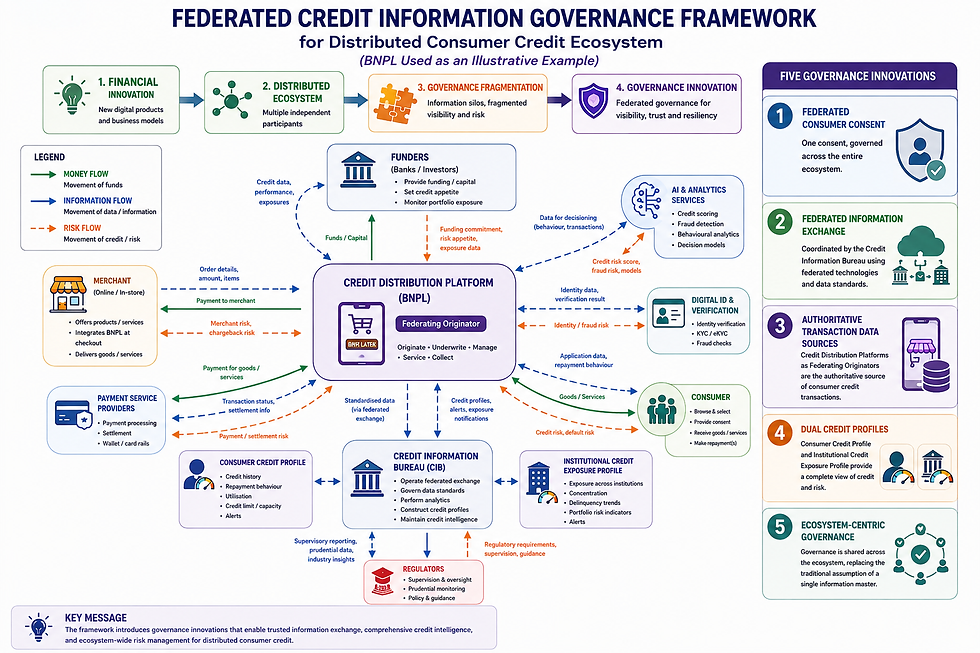
The proposed Federated Credit Information Exchange and Governance Framework (FCIEGF) establishes a governed ecosystem in which each participant continues to perform its existing business responsibilities while exchanging authorised information through Federation Technologies.
Rather than centralising operational data or replacing existing institutional governance, the framework coordinates the flow of information, analytics, credit profiles, and risk intelligence across independent organisations. Each participant remains accountable for its own decisions, while the Credit Information Bureau serves as the trusted coordinator of federated information exchange and governed credit intelligence.
The overall governance architecture consists of seven sequential governance layers.
Layer (1): Consumer Consent
Responsible Party:
· Consumer
Primary Function:
· Provide Federated Consumer Consent at Loan Origination
Output:
· Authorised information rights
Layer (2): Credit Organization
Responsible Party:
· Merchant and Credit Distribution Platform (BNPL Provider)
Primary Function:
· Create the commercial transaction and the consumer credit transaction;
· Submit standardised transaction information.
Output:
· Standardised credit information
Layer (3) Federated Information
Responsible Party:
· Credit Information Bureau (using Federated Technologies)
Primary Function:
· Receive authorised and standardised consumer credit information from participating Credit Distribution Platforms (e.g. BNPL providers) through Federated Technologies without permanently centralising operational data.
· Coordinate governed information exchange across participating organizations.
· Validate, standardise and prepare authorised information for credit analytics and profile construction.
Output:
· Governed information repository
· Governed information exchange services
· Standardised information for credit analytics
Layer (4) Credit Analytics
Responsible Party:
· Credit Information Bureau
Primary Function:
· Construct and maintain Consumer Credit Policies and Institutional Credit Exposure Profiles
Output:
· Governed credit profile
Layer (5) Credit Profile Construction
Responsible Party:
· Credit Information Bureau
Primary Function:
· Construct and maintain Consumer Credit Profiles and Institutional Credit Exposure Profiles
Output:
· Governed credit profile
Layer (6) Risk Management and Credit Decisions
Responsible Party:
· Banks, Financiers and Other Authorised Credit Providers
Primary Functions:
· Access authorised credit profiles to support consumer lending, institutional lending, portfolio monitoring and prudential reporting
Output:
· Better-informed credit and risk decisions
Layer (7) Regulatory Oversight
Responsible Party:
· Financial Regulators
Primary Functions:
· Establish governance standards and supervise compliance using improved prudential information
Output:
· Financial stability and ecosystem governance
Key Observation
Unlike today’s predominantly institution-centric governance model, the proposed framework establishes an ecosystem-centric governance architecture in which Federated Technologies enable governed information exchange, while the Credit Information Bureau transforms authorised information into governed credit intelligence for the benefit of the entire consumer credit ecosystem.
4.3 BNPL is a loan
The proposed framework recognises that every Buy Now, Pay Later transaction is fundamentally a consumer credit transaction, irrespective of whether repayment is made through a single deferred payment, multiple instalments, or a combination of upfront and deferred payments. The financing component should therefore be governed as a loan, distinct from the underlying commercial purchases.
Although consumer experience a seamless purchasing journey, the framework distinguishes between two related but separate transactions:
· The commercial transaction, involving the purchase of goods or services; and
· The consumer credit transaction, representing the financing arrangement
Accordingly, consumers should receive a clear financing confirmation or loan statement identifying the credit obligation independently from the commercial purchase. This distinction enhances transparency, financial literacy, audibility, and credit reporting without reducing customer convenience.
Within the proposed architecture, the customer-facing credit distribution platform, including BNPL providers, performs the role of Federating Originator. It originates the consumer credit transaction, maintains its identify throughout the credit lifecycle, allocates funding to participating financiers, and submits standardised credit information for governed exchange.
Rather than centralizing information, the framework enables participating organizations to retain stewardship over their own information while exchanging authorised information through Federated Technologies. The Credit Information Bureau become the coordinated information exchange layer supporting the wider consumer credit ecosystem.
4.4 Federated Consumer Consent
Consumer consent forms one of the fundamental governance mechanisms within the framework.
At the time a consumer credit transaction is originated, the consumer provides explicit, informed, and transparent consent authorising identified participants to collect, exchange, analyse, and use relevant information for clearly specified purposes.
The consent should clearly identify:
· participating organisations authorised to process information;
· categories of information to be collected;
· authorised operational uses;
· authorised analytics uses:
· use of identifiable information;
· use of de-identified information;
· retention periods;
· consumer rights relating to access, correction, and withdrawal, where permitted by applicable laws and regulations.
Rather than requesting multiple bilateral consents throughout the ecosystem, the proposed Federated Consumer Consent model establishes a single governance mechanism governing authorised information usage across participating organizations.
4.5 Federated Information Exchange Governance
The proposed framework introduces the Credit Information Bureau (CIB) as the central coordinator of governed information exchange within the distributed consumer credit ecosystem.
Unlike traditional credit reporting models, the CIB does not require participating organizations to permanently transfer or centralise all customer information. Instead, participating organizations continue to retain stewardship of information that they legitimately collect.
Through Federated Technologies, the CIB is authorised to obtain the information necessary to construct and maintained governed credit information services.
For each consumer credit transaction, the Credit Distribution Platform (for example, A BNPL platform) acts as the Federating Originator by submitting standardised transaction information to the CIB.
As the Federating Originator, the Credit Distribution Platform becomes the authoritative source of raw consumer credit transaction information throughout the credit lifecycle. Rather than acting as the ecosystem information master, it fulfils the governance responsibility of originating the maintaining the integrity of transaction data before authorised information is exchanged through Federated Technologies. Multiple Credit Distribution Platforms collectively form a distributed network of authoritative information sources supporting the wider consumer credit ecosystem.
Using federated data exchange, the CIB continuously receives authorised updates from participating organisations throughout the credit lifecycle. The CIB then applies governed analytics to construct two complementary information services:
· Consumer Credit Profiles, reflecting the consumer’s aggregated authorised credit obligations across participating credit providers; and
· Institutional Credit Exposure Profile, reflecting the aggregated consumer credit exposure of participating financiers.
The framework therefore avoids permanent centralisation of operational data while enabling the CIB to maintain continually updated credit information products.
Access to these profiles remains governed according to purposes, authorisation, consumer consent where applicable, and relevant legal and regulatory requirements.
Information governance therefore extends beyond traditional data management o encompass:
· information stewardship;
· standardised information submission;
· federated information exchange;
· profile construction;
· lifecycle updates;
· interoperability;
· auditability;
· commercial utilisation governance;
· privacy protection; and
· regulatory compliance.
As such, the CIB evolves from a passive repository of historical credit information into an active federated information exchange platform supporting ecosystem-wide credit governance.
4.6 Federated Analytics Governance
Within the proposed framework, the Credit Information Bureau (CIB) performs the governed analytical functions necessary to transform authorised information received through the Federated Information Exchange Framework into actionable credit intelligence. Using Federated Technologies, the CIB continuously receives authorised and standardised information from Credit Distribution Platforms and other participating organisations without requiring the permanent centralisation of operational data.
The CIB applies governed analytical models to support a range of credit-related activities, including credit assessment, fraud detection, behavioural analysis, portfolio monitoring, AI-assisted decision support, and early warning indicators. Rather than replacing the credit judgement of banks or other lenders, these analytical outputs provide more comprehensive and timely information to supported informed decision-making.
The framework distinguishes three categories of governed analytics
· Operational Analytics: supporting day-to-day credit assessment, fraud detection, repayment monitoring, and operational risk management.
· Portfolio Analytics: supporting the analysis of consumer credit portfolios, institutional credit exposures, concentration risks, and prudential supervision.
· Development Analytics: supporting analytical model development, model validation, AI model improvement, benchmarking, and research.
Where consumer information is used for analytical model development or commercial analytical services, such activities shall be transparent, purpose-specific, and governed under the Federated Consumer Consent Framework. Wherever practical, de-identified information should be used to minimise privacy risks while supporting responsible innovation.
Accordingly, the Credit Information Bureau becomes responsible not only for maintaining credit information but also for generating governed analytical intelligence that supports the construction of credit profiles and improves ecosystem-wide credit risk visibility.
4.7 Credit Profile Construction and Governance
Using the governed analytical outputs generated under Section 4.5, the Credit Information Bureau (CIB) constructs and continually maintain two complementary categories of credit profiles through the Federated Information Exchange Framework.
The Consumer Credit Profile provides an aggregated and continually uploaded view of a consumer’s authorised credit obligations across participating credit providers. The profile supports responsible lending by enabling authorised banks, finance companies, and other credit providers to obtain a more comprehensive understanding of a consumer’s existing credit commitments when assessing new credit applications or reviewing existing facilities.
The Institutional Credit Exposure Profile provides and aggregated and continually updated view of the consumer credit portfolios supported by participating financiers, including BNPL providers, finance companies, and other lending institutions. This profile enables authorised commercial banks and other funding institutions to better understand the scale, composition, concentration, and changing risk characteristics of the consumer credit portfolio financed by their institutional clients.
Importantly, commercial banks do not require direct access to individual consumer information maintained by participating financiers. Instead, where relevant and necessary, authorised banks access the Institutional Credit Exposure Profile maintained by the Credit Information Bureau to support Institutional lending decisions, portfolio monitoring, ongoing credit reviews, and prudential reporting.
The Credit Information Bureau is responsible for maintaining the integrity, accuracy, timeliness, and governance of both categories of credit profiles through the application of Federated Technologies, authorised information received from participating organisations is continually incorporated into the profile construction process, enabling more proactive credit risk management while preserving consumer privacy and organisational data stewardship.
Accordingly the proposed framework extends the traditional role of Credit Information Bureau from maintaining historical credit records to constructing and maintaining governed consumer and institutional credit profiles that support responsible lending, institutional risk management, and financial stability.
4.8 Federated Risk Governance
The proposed framework introduces Federated Risk Governance to improve ecosystem-wide risk visibility while preserving the responsibilities of individual organizations. Rather than centralising risk management, the framework enables each participant to continue managing its own risks using more comprehensive and timely information obtained through governed information exchange.
The governance process involves the following participants.
Consumer
Consumers remain responsible for providing accurate information during the credit application process and for meeting their contractual repayment obligations. At the point of loan origination, consumers provide Federated Consumer Consent authorizing the collection, exchange, and authorised use of their information for specified operational, analytical, and regulatory purposes.
Merchants
Merchants initiate the commercial transaction by supplying accurate purchase information to the BNPL platform. Their primary responsibility is to ensure the integrity of the commercial transaction rather than the management of consumer credit risk.
Credit Distribution Platform (BNPL Providers)
The BNPL platform acts as the Federating Originator. It originates the consumer credit transaction, performs customer onboarding and affordability assessment, allocates the financial request to one or more participating funding institutions, administers the repayment process, and continuously submits standardised credit transactions updates to the Credit Information Bureau through Federated Technologies.
This reporting responsibility remains with the Federating Originator throughout the credit lifecycle, ensuring that consumer credit information remains current regardless of changes in funding arrangements.
Funding Institutions
Funding institutions – including commercial banks, finance companies, and private credit funds – provide the capital supporting BNPL transactions. They continue to manage their own credit, liquidity, and portfolio risks.
Where authorised and relevant, funding institutions may access Consumer Credit Profiles from Credit Information Bureau to support consumer lending decisions and Institutional Credit Exposure Profiles to support the ongoing assessment of BNPL providers and other institutional borrowers. Rather than waiting for periodic portfolio reviews, funding institutions benefit from more current ecosystem information to support proactive credit risk management.
Credit Information Bureau
The Credit Information Bureau performs the central coordinating role within the proposed framework. Using Federated Technologies, it receives authorised and standardised credit information from participating Credit Distribution Platforms and other authorised contributors without requiring the permanent centralisation of operational data.
The Credit Information Bureau applies governed analytics to construct and maintain:
· Consumer Credit Profiles, reflecting authorised consumer credit obligations across participating credit providers; and
· Institutional Credit Exposure Profiles, reflecting the aggregate consumer credit exposure of participating funding institutions.
These profiles are continuously updated as authorised information is received through the federated information exchange framework.
Analytical Providers
Authorized analytics providers develop credit scores, portfolio analytics, early warning indicators, and AI-assisted analytical models using information made available through the governance framework. Their activities remain subject to purpose limitation, Federated Consumer Consent where appliable, transparency requirements, and regulatory oversight.
Banks Providing Institutional Finance
Commercial banks that provide credit facilities to BNPL providers or other financing institutions remains responsible for their own institutional credit assessments.
When conducting periodic credit reviews, monitoring existing facilities, or preparing prudential reports for financial regulators, authorised banks may access the institutional Credit Exposure Profile maintained by the Credit Information Bureau. This enables banks to better understand the aggregate consumer credit exposure and portfolio characteristics of their institutional clients without requiring direct access to individual consumer records.
Financial Regulators
Financial regulators establish the governance standards governing information exchange, privacy protection, interoperability, consumer protection, and prudential supervision. Rather than collecting detailed transaction information directly from each participant, regular benefit from high quality supervisory reporting produced by regulated institutions using more comprehensive ecosystem information available through the framework
Key Observation
Under the proposed framework, each participant continues to perform its existing responsibilities. The innovation lies not in transferring those responsibilities to central authority, but in enabling authorised participants to make better-informed decisions through Federated Technologies, governed information exchange, and continuously updated consumer and institutional credit profile.
4.9 Stakeholder Responsibilities
The framework establishes complementary responsibilities across the consumer credit ecosystem.
Consumers provide accurate information, manage their credit obligations responsibly, and determine the scope of authorised information usage through Federated Consumer Consent.
Merchants provide accurate commercial transaction information.
Credit distribution Platforms act as Federating Originator, maintaining transaction integrity and submitting standardised information for governed exchange.
Funding institutions remain responsible for prudent lending decisions and portfolio risk management.
Credit Information Bureaus facilitate governed information exchange, maintain consumer credit profiles and institutional credit exposure profiles, and provide authorised information services.
Analytical providers perform governed analytics consistent with authorised purposes and consumer consent.
Regulators establish governance standards, supervise compliance, and promote financial stability.
Each participant remains accountable for its own activities while contributing to ecosystem-wide governance.
4.10 Governance Framework Innovation
Innovation (1): Funding independence
Existing Practice:
· Information fragments when funding structures change
Proposed Framework:
· Governance follows the credit transaction regardless of funding structure
Innovation (2): Continual profile update
Existing Practices:
· Periodic reporting
Proposed Framework:
· Continually updated consumer and institutional profiles enabled by Federated Technologies
Innovation (3): Dual credit profiles
Existing Practices:
· Consumer profile only
Proposed Framework:
· Consumer and institutional credit profiles
Innovation (4) Quality risk intelligence
Existing Practices:
· Institution-specific analytics
Proposed Framework:
· Ecosystem-wide governed analytics generated by the CIB
Innovation (5) Risk governance
Existing Practice:
· Institution-centric
Proposed Framework:
· Ecosystem-centric
Innovation (6) Prudential reporting
Existing Practice:
· Based largely on individual bank information
Proposed framework:
· Enhanced by governed ecosystem-wide credit intelligence
Consumer privacy
· Multiple organizations access different datasets
Proposed Framework:
· Authorised access to governed profiles rather than widespread access to raw data
Key Observation
Regardless of how consumer credit is originated, distributed, funded, or transferred, the proposed Federated Credit Information Exchange and Governance Framework uses Federated Technologies to enable the Credit Information Bureau to maintain continually updated consumer and institutional credit profiles, therefore providing banking with higher-quality credit intelligence and supporting higher-quality prudential reporting to financial regulators.
5 DISCUSSION, IMPLICATIONS AND FUTURE RESEARCH DIRECTIONS
5.1 Potential Applications
Although Buy Now, Pay Later (BNPL) provides the reference case for this article, the proposed Federated Credit Information Exchange and Governance Framework is not designed specifically for BNPL. Instead, it establishes a product-independent governance architecture capable of supporting a broad range of distributed consumer credit products.
As financial innovation continues to distribute information, funding, and credit risk across multiple independent organisations, the same governance principles can potentially be applied to:
Buy Now, Pay Later (BNPL);
Credit Cards;
Personal Loans;
Auto Finance;
Student Loans;
Embedded Finance;
Digital Banking;
Open Finance;
AI-driven Lending; and
Future Consumer Credit Products.
The framework is particularly relevant where multiple organisations participate in originating, funding, servicing, or managing consumer credit, creating fragmented information and distributed risk. Rather than developing separate governance arrangements for each new financial product, the proposed framework provides a common governance architecture supported by Federated Technologies.
Key Message
The innovation lies not in governing a particular financial product, but in establishing a scalable governance architecture capable of supporting future generations of distributed consumer credit ecosystems.
5.2 Hong Kong Perspective
Hong Kong provides an interesting environment for exploring the implementation of ecosystem-centric consumer credit governance.
As an international financial centre, Hong Kong combines a mature banking sector, strong regulatory infrastructure, and an active fintech ecosystem. These characteristics provide a suitable foundation for examining how governance innovation can support the continued evolution of digital financial services.
Several existing developments are particularly relevant to the proposed framework, including:
a mature banking and financial services market;
established consumer protection and prudential regulatory frameworks;
Open Banking initiatives;
Commercial Data Interchange (CDI);
digital banking development; and
increasing adoption of fintech and artificial intelligence applications.
The Hong Kong market demonstrates an important balance between innovation and governance. While financial institutions and fintech companies continue to develop new products and services, maintaining financial stability, consumer protection, and risk transparency remains a key regulatory priority.
The proposed Federated Credit Information Exchange and Governance Framework does not seek to replace existing regulatory arrangements. Instead, it provides a potential governance architecture to enhance interoperability, information visibility, and proactive risk management across a distributed consumer credit ecosystem.
Hong Kong's combination of financial maturity, technological readiness, and regulatory experience provides a valuable environment for exploring how governance innovation can enable further financial innovation.
Key Message
Hong Kong provides a practical environment for exploring ecosystem-centric consumer credit governance, where the challenge is no longer only technological capability, but the alignment of governance, information exchange, and risk management across multiple participants.
5.3 Implementation Considerations
Successful implementation depends less on technology availability and more on governance alignment among ecosystem participants.
Key consideration includes:
· stakeholder collaboration;
· information standards;
· identification and governance of authoritative transaction data sources
· legal and regulatory alignment;
· consumer trust;
· privacy protection;
· industry incentives; and
· phased implementation.
Federated Technologies provide the technical foundation, but governance innovation determines who is responsible for originating authoritative consumer credit transaction data, how information is exchanged, analysed, and governed, and how ecosystem-wide credit intelligence is constructed through the Credit Information Bureau. Successful implementation therefore depends on aligning governance responsibilities across the distributed consumer credit ecosystem rather than on technology alone.
Key Message:
Governance alignment is the critical success factor for implementing the framework.
5.4 Future Research
The proposed framework provides a foundation for future research in areas including:
· federated governance principles;
· consumer information rights;
· Ai governance;
· privacy-preserving information exchange
· credit information Bureau evolution;
· institutional credit exposure analytics
· regulatory architecture;
· cross-border consumer credit governance; and
· empirical validation
Key Message:
The framework represents a starting point for future research and industry exploration rather than a final solution
5.5 Limitation
This article has several limitations. Firstly, BNPL is used as the reference case, although the framework is intended to apply more broadly. Secondly, the framework is conceptual and requires validation and practical implementation testing. Thirdly, the framework adopts a jurisdiction-neutral perspective and does not examine detailed legal requirements across individual markets. Finally, cross-border implementation challenges remain outside the scope of this article.
These limitations provide opportunities for future refinement and research.
Key Message:
The proposed framework is a conceptual governance architecture intended to stimulate further discussion, research, and industry development.